
The pump needs replacing, but the motor is still in good condition. For many maintenance teams, buying a bare shaft pump sounds like the straightforward answer: keep the existing motor and replace the pump unit.
Sometimes it is. But a replacement pump that looks right in a photograph can still be difficult to install. The mounting face may line up while the coupling does not. The motor may fit the bracket but have the wrong speed for the expected pump performance.
These are avoidable problems when the right information is checked before the order is placed.
For U.S. repair shops and buyers working with vertical multistage pumps and NEMA motors, here are seven checks to make before placing an order.
First, What Is a NEMA Bare Shaft Pump?
In this context, a bare shaft pump is a pump supplied without an electric motor. It lets a buyer consider reusing an existing motor or sourcing one locally.
The term does not define one universal package. Depending on the pump design and supplier, the quotation may cover the pump unit alone or a configuration that also includes a motor support, coupling components, or other installation items. Always confirm the scope of supply rather than assuming those parts are included.
A NEMA-compatible version is configured for a specified NEMA motor mounting arrangement. That does not mean it will accept every NEMA motor, or even every motor described as C-face. See our NEMA Bare Shaft Pumps page for the product category and configuration review.

Representative bare shaft pump photograph. Final NEMA interface and coupling details depend on the selected configuration.
1. Confirm the Complete NEMA Motor Frame Designation
Start with the existing motor nameplate. The full frame designation matters, including its suffix.
For example, 184TC and 213TC are not interchangeable descriptions. The complete codes identify different frame arrangements. Keep the TC suffix when requesting a C-face configuration; other suffixes can indicate different shaft or mounting arrangements.
Do not send a supplier only “NEMA motor” or “5 HP motor” and expect a reliable fit assessment. Motor power alone does not identify the mechanical interface.
If the frame marking is missing or uncertain, obtain the motor manufacturer’s dimensional drawing or measure the relevant interface with appropriate equipment.
2. Check the C-Face, Shaft and Coupling Together
This is where seemingly simple replacements can become complicated.
The motor’s mounting interface includes more than a set of bolt holes. Important details can include:
- C-face pilot and bolt-circle dimensions.
- Shaft diameter and keyway.
- Shaft extension or projection from the mounting face.
- Coupling type and required engagement.
- Motor support or adapter dimensions.
- The axial position required by the particular pump assembly.
For example, the C-face drawings in ABB’s NEMA Super-E motor catalog list the 182TC/184TC and 213TC/215TC groups with the same pilot diameter and bolt-circle diameter, but different shaft diameters, key sizes, and axial dimensions. These catalog examples explain the risk; use the drawing for the exact motor catalog number to confirm the actual interface.
So the fact that a motor can be bolted to a bracket does not prove the coupling will fit correctly.
Changing the coupling alone may also be insufficient. If the replacement coupling cannot reach the motor shaft or does not provide the required engagement, a different motor support or adapter arrangement may be needed. Whether such a conversion is practical depends on the actual pump and motor drawings.
For this reason, a supplier should confirm the complete pump-to-motor connection—not just a frame number on a product list.
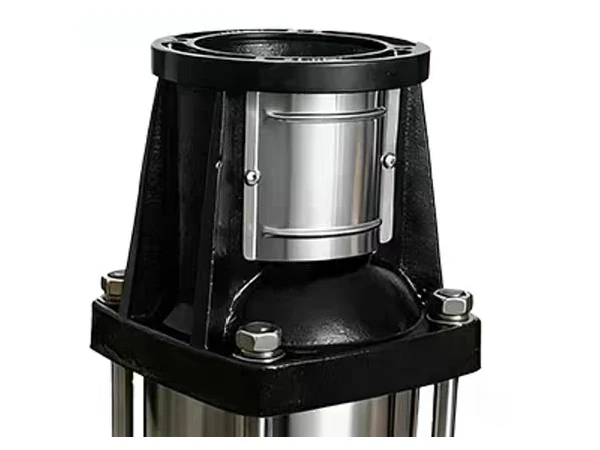
Motor support and coupling guard, cropped from the same product photograph. The internal coupling is covered; dimensions and engagement require separate confirmation.
3. Verify Motor Speed and Available Power
Next, check what the existing motor can actually deliver.
Record the motor’s rated power, frequency, rated speed, phase and voltage. For a North American installation, a 60 Hz motor is common, but the nameplate remains the authority for the specific motor.
Two motors with similar power ratings can operate at different speeds. A vertical multistage pump selected for one rotational speed will not necessarily deliver the required flow and head when driven at another.
Do not assume a pump curve based on 50 Hz operation describes what the assembly will do at 60 Hz, or vice versa. Use performance data for the intended operating speed.
The available motor power also has to be sufficient for the pump’s expected operating range and liquid properties. Matching by horsepower alone, without checking the hydraulic duty, can lead to an unsuitable selection.
Some vertical multistage designs impose axial loads that make the motor bearing arrangement important. The Grundfos CR data booklet, for example, specifies heavy-duty motor bearings for thrust requirements. This is a design-specific example, not a rule that all bare shaft pumps have the same thrust arrangement. Confirm the axial-load path, permitted motor mounting orientation, and required bearing capability with the pump and motor manufacturers. Adequate horsepower and a matching C-face do not establish suitability.
4. Match the Pump to the Actual Duty Point
If the goal is to replace an existing pump without changing system operation, collect the original duty conditions:
- Required flow rate, with units such as US gpm or cubic meters per hour.
- Required total head or pressure rise across the pump, with units such as feet, meters, or psi; do not treat these as identical quantities.
- Operating speed.
- Liquid type and temperature.
- Relevant inlet pressure and operating conditions.
Compare those requirements with the proposed replacement pump’s performance curve.
A model designation or the number of impeller stages can help with identification, but neither is a substitute for verifying the duty point. Two pumps that look similar may have different impeller geometry, stage arrangements or operating curves.
Also ask whether the system has changed. A pump originally selected for one operating point may no longer be suitable after changes to piping, controls or production demand. Replacing it with a nominally equivalent unit may repeat the same performance problem.
5. Check Physical Installation Dimensions
Even when the motor interface and pump performance are correct, the new unit still needs to fit the installation.
Confirm the dimensions that matter to the site:
- Suction and discharge connection sizes and types, including flange standard/rating or thread specification where applicable.
- Position and orientation of the pipe connections.
- Mounting base and anchor-bolt locations.
- Overall height and service clearance.
- Available space around the motor support and coupling.
This is particularly important when the existing piping will remain in place. Small changes in connection position can create extra installation work.
Do not try to identify IEC and NEMA configurations from the external appearance of the motor support alone. Similar-looking pump assemblies can have different mechanical interfaces. Drawings and verified dimensions are more dependable than photographs.
6. Confirm Wetted Materials and Application Requirements
A motor may be reusable while the original pump materials are no longer the right choice for the liquid being handled.
Before confirming the replacement, review the fluid, temperature, possible solids, and chemical conditions. Check the proposed wetted materials and mechanical seal arrangement against the application.
For example, a pump suitable for ordinary clean-water service should not automatically be treated as suitable for a different chemical or a higher-temperature duty.
If the project requires drinking-water approvals or other specific documentation, request evidence for the exact product configuration being supplied. A general claim about a product family is not enough to establish that a particular delivered assembly meets the requirement.
7. Agree on the Scope of Supply Before Quotation Approval
The phrase bare shaft pump can create misunderstandings if the quotation does not clearly state what arrives in the shipment.
Ask the supplier to confirm:
| Item | Question to resolve |
|---|---|
| Pump unit | Which pump model, stage arrangement and material version are included? |
| Motor | Is the motor excluded, as expected? |
| Motor support | Is the NEMA-compatible bracket or adapter included? |
| Coupling | Are the required coupling parts included and matched to the stated motor frame? |
| Mechanical seal | Is it fitted, and which seal arrangement is supplied? |
| Documentation | Are the relevant performance curve and dimension drawing available? |
| Installation | Are any additional parts or site modifications expected? |
This does not mean every order needs a long engineering review. For a familiar repeat purchase, a confirmed pump and motor combination may make the process quick. For an unfamiliar replacement, a few extra questions before shipping are usually worthwhile.
What If the Existing Motor Uses an IEC Frame?
An IEC motor should not be assumed to connect directly to a pump prepared for a NEMA motor. The mounting and shaft interfaces need to be checked separately.
Where both IEC and NEMA pump configurations are available, identify the existing motor standard at the start and request the corresponding configuration. Any conversion between standards should be evaluated as a specific mechanical arrangement, not treated as a simple label change.
REPLACEMENT SUPPORT
Keeping Your NEMA Motor?
Share the pump and motor details to review the required connection and replacement configuration.
Request a QuoteWhat to Send When Requesting a NEMA Bare Shaft Pump
You do not need to prepare a complete engineering package for the first enquiry. The following details are usually a good starting point:
- Existing pump nameplate: A clear photo, or the complete model designation.
- Existing motor nameplate: Especially the full NEMA frame, horsepower, frequency and speed.
- Pump duty: Flow rate, head or pressure requirements, liquid and temperature.
- Installation information: A dimension drawing or clear photos showing the pump, motor support and pipe connections.
- Supply requirement: Whether the existing motor will be reused and whether the motor support and coupling are needed.
If you can supply the model and nameplate photos first, the remaining questions can be handled during technical confirmation.
A Replacement Should Fit the Motor and the Job
Reusing a suitable motor can be a sensible way to control replacement cost and reduce unnecessary changes on site. But the advantage disappears when a mismatched coupling, bracket or pump duty causes delays during installation.
The best starting point is to confirm three things together: the existing motor, the required pump performance and the installation dimensions.
For a broader repair-scope decision, compare the stack kit, bare shaft pump, and complete pump options.