
To identify a replacement mechanical seal, start with the complete pump identification, then check the seal construction, dimensions, and operating conditions. Similar-looking seals are not necessarily interchangeable.
Before you start
- Pump identification: Complete model or a clear nameplate photograph.
- Existing seal: Front and side photographs, if available.
- Dimensions: Shaft diameter, seat dimensions, and installed length where known.
- Operating conditions: Pumped liquid, temperature, and pressure where known.
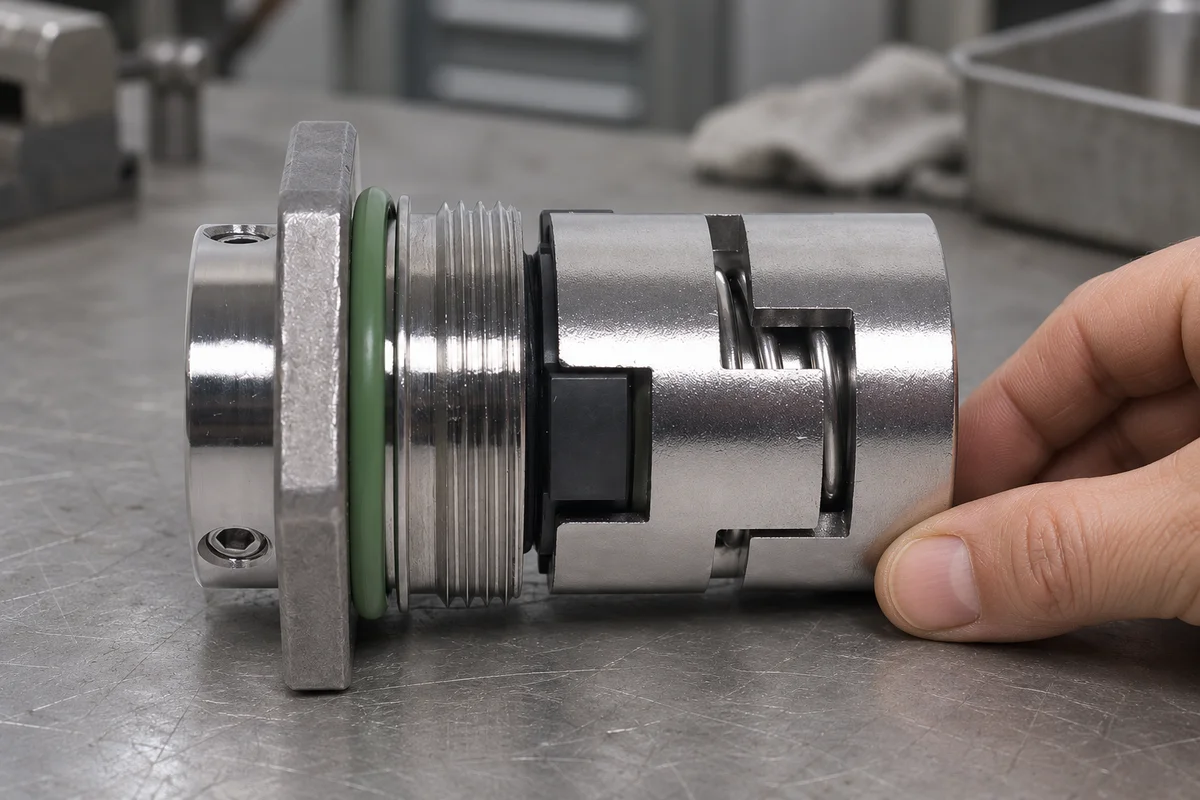
External construction of a mechanical seal during visual inspection.
1. Start With the Pump Model, Not Just the Seal
The pump nameplate is usually the best place to begin.
Look for the complete model designation, product or identification number, and any shaft seal code or part number. If you have a maintenance record showing the previously installed seal, keep that information as well.
For vertical multistage pumps, references such as CR, CDL, or CDM may help identify the pump family. But the series name alone doesn’t establish that two mechanical seals are interchangeable.
A more useful starting point is the complete identification from the nameplate.
If the pump is still installed, take a clear photograph of the nameplate before arranging any further inspection. It can save unnecessary back-and-forth later.
2. Check the Seal Type and Critical Dimensions
If the old seal has already been removed, examine the complete assembly before separating any additional parts.
Is it a cartridge seal, a rubber bellows design, or another component-type arrangement? Does it have a separate stationary seat? Are there identification markings on the metal components?
These details can help narrow down the replacement.
However, appearance alone is not enough. The main dimensions still need to be checked.
| What to check | Why it matters |
|---|---|
| Shaft or sleeve diameter | Establishes the size of the surface where the seal is fitted |
| Stationary seat diameter | Helps confirm whether the seat fits the housing |
| Seat thickness and shape | Identifies differences between similar-looking seat designs |
| Seal working or installed length | Helps verify the intended assembled dimensions |
| Seal construction | Distinguishes cartridge, bellows, and other arrangements |
1. Shaft diameter
Check the shaft or sleeve where the seal is fitted.
2. Stationary seat
Record the seat dimensions and photograph its profile.
3. Working / installed length
Use the specified working position and reference faces in the seal drawing. Do not substitute the free length of the removed seal.
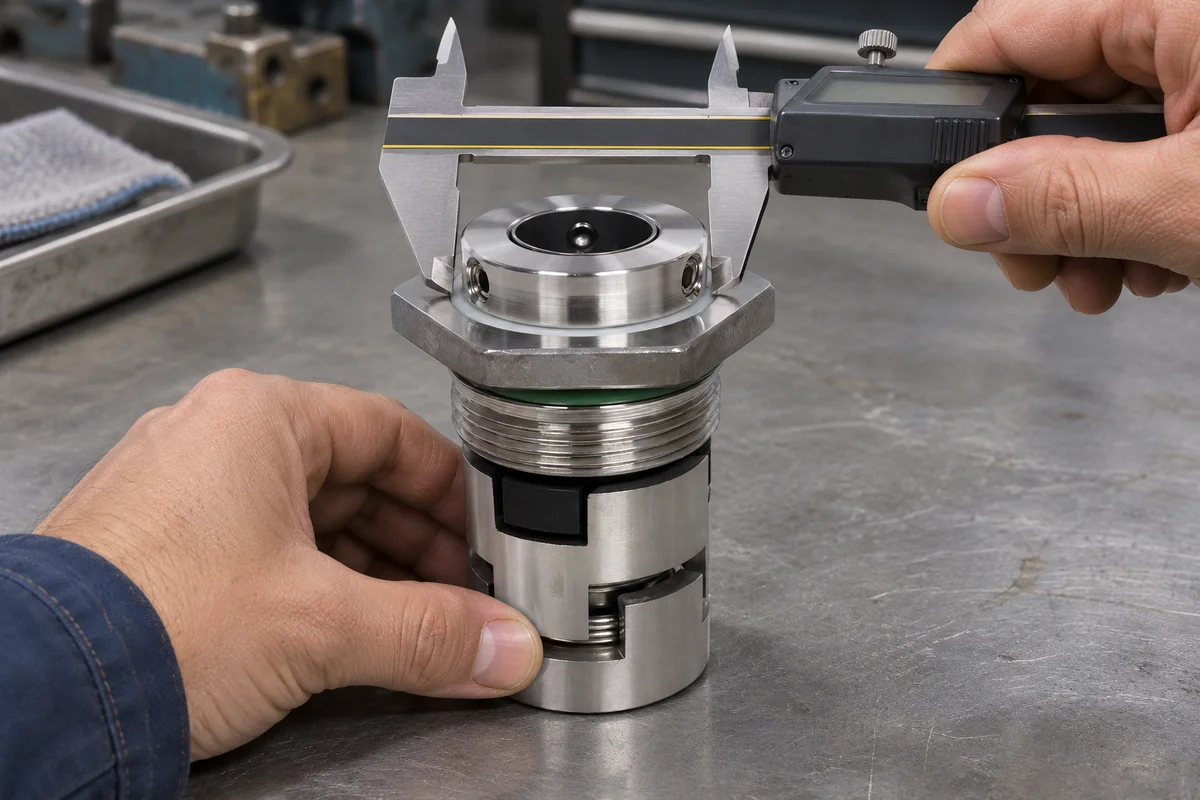
External collar diameter check. Use the specific seal drawing to confirm critical dimensions.
Shaft diameter is important, but it isn’t the whole specification
Suppose you have a seal for a 22 mm shaft.
That measurement is useful, but it doesn’t automatically mean every 22 mm mechanical seal will fit. The stationary seat and installation dimensions may still be different.
When measuring, check the shaft or sleeve diameter at the actual seal installation location. Measuring another part of the shaft can lead to confusion.
For a removed seal, use a suitable measuring tool and record the dimensions in millimeters. If a part is badly worn or damaged, mention that the measurement may be approximate.
A matching shaft diameter is a starting point for identification, not confirmation of complete compatibility.
3. Take Photos That Help With Identification
Good photographs can sometimes answer questions that are difficult to explain in an email.
For a mechanical seal inquiry, the following images are particularly useful:
- Pump nameplate: Show the complete model and identification information clearly.
- Complete seal assembly: Take front and side views so the overall construction can be seen.
- Stationary seat: If safely removed, photograph the seat separately, including its profile.
- Measured dimensions: Show the caliper reading together with the component being measured.
Try to photograph the parts against a clean background. A clear side view is often more useful than several photographs taken from almost the same angle.
There’s no need to dismantle an operating pump simply to provide these pictures. If the seal is still installed, start with the pump identification and whatever documentation is already available.
4. Don’t Overlook the Operating Conditions
A replacement seal must do more than physically fit the pump.
It also needs to be suitable for the liquid and operating conditions.
For example, a seal used in a clean-water application may not require the same material combination as one used with a different chemical or at a higher operating temperature.
When requesting a replacement, try to confirm:
- Pumped liquid and whether it contains particles
- Normal operating temperature
- Operating pressure
- Pump or shaft speed, if available
- Any known history of leakage or premature seal failure
This information helps with reviewing seal-face and elastomer material suitability.
If the operating conditions are unknown, say so rather than selecting materials based only on the appearance of the old components.
5. What If the Original Seal Is Missing?
This happens in replacement sourcing. A pump may already have been dismantled, or the old seal may be too damaged to identify.
In that situation, begin with the pump information you still have.
The complete model, nameplate photograph, original spare-part reference, or manufacturer documentation may provide a useful starting point.
If you have an exploded drawing or spare-parts list, share the relevant page. It can help clarify the original seal arrangement.
You can also provide the dimensions of the available shaft, sleeve, or seal housing where appropriate.
Not every request can be confirmed from a pump model alone. Some configurations will require additional dimensional checks or a comparison with the original assembly.
The important thing is to separate what has been verified from what is still uncertain.
REPLACEMENT SUPPORT
Need Help Matching a Seal?
Share your pump model or seal details for replacement review.
Request a Quote6. Common Mistakes When Ordering Replacement Mechanical Seals
A few avoidable mistakes can make replacement sourcing more difficult.
Ordering from a product photo alone
A photograph may show the general seal design, but it cannot reliably establish all critical dimensions or materials.
Providing only the shaft diameter
A statement such as “22 mm mechanical seal required” is a useful start, but the seat design, installation length, and pump identification may still be needed.
Assuming seals from the same pump family are interchangeable
Even within a familiar pump series, different versions and configurations may use different seals. Check the specific pump rather than relying on the series name.
Ignoring the pumped liquid
A dimensionally suitable seal is not necessarily appropriate for every fluid or operating temperature.
Reordering the old seal without checking the cause of failure
If the original seal failed unusually early, review our mechanical seal leakage troubleshooting guide before ordering. It covers operating and installation causes that matching dimensions alone cannot resolve.
7. What Information Should You Send for a Quotation?
You don’t need to prepare a lengthy technical report for the first inquiry.
A practical starting point is:
| Information | What to provide |
|---|---|
| Pump identification | Complete model or nameplate photograph |
| Required component | Mechanical seal or available part number |
| Shaft diameter | Measured size, if known |
| Existing seal | Photos or relevant dimensions, if available |
| Operating conditions | Liquid, temperature, and pressure where known |
| Quantity | Number of replacement sets required |
For example, an inquiry that includes a full nameplate photograph, a measured shaft diameter, and a photograph of the old seal gives the supplier more to work with than a request saying only “seal for vertical pump.”
It may still be necessary to confirm additional details before final selection. That’s normal, particularly when replacing older components or working without the original spare-parts documentation.
Final Thoughts
Identifying a replacement mechanical seal is mainly about collecting the right information in the right order.
Start with the complete pump identification. Check the original seal and its critical dimensions where possible. Then confirm that the proposed replacement suits the operating conditions.
The goal isn’t to gather every possible measurement before making contact. It’s to provide a reliable starting point and make clear which details still need confirmation.
Final compatibility should be confirmed against the specific pump configuration before ordering.